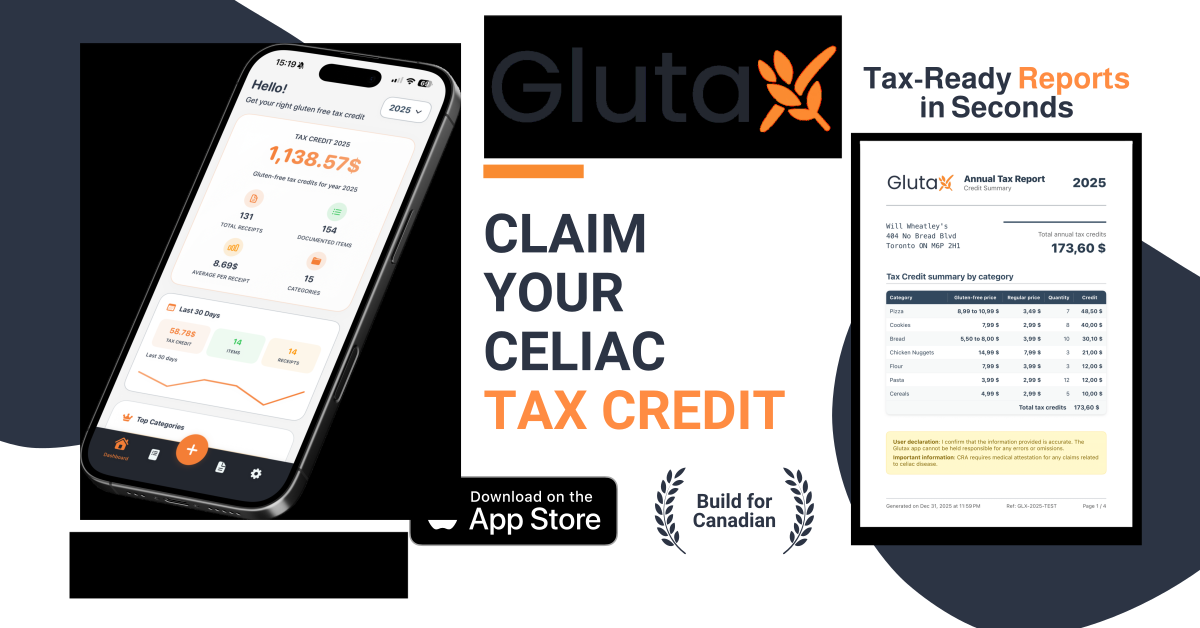
Celiac Tax Credit Canada: How to Claim in 2026

Yes. In Canada, a person with celiac disease who needs a gluten-free diet may claim the incremental cost of eligible gluten-free products as a medical expense. You cannot claim the full grocery price, and this is not a separate Disability Tax Credit. Keep a medical practitioner's letter, your receipts, and a product summary with your calculations.
Living with celiac disease means following a strictly gluten‑free diet with no exceptions. It is not a preference, but a lifelong medical treatment. In Canada, that reality has a direct consequence: gluten‑free foods cost significantly more, and the extra cost adds up month after month.
What many people call the celiac disease tax credit is the medical expense tax credit applied to eligible incremental food costs. In theory, the principle is simple. In practice, documenting every purchase and comparison can be complex, administrative, and discouraging.
Filing in 2026 usually means filing your 2025 tax return. If you are tracking 2026 purchases, use the rules and thresholds for the tax year you will claim them in. The examples below calculate eligible expenses, not a guaranteed refund.
Why gluten‑free foods cost more in Canada
Before talking about taxes, let’s look at concrete numbers.
The gluten‑free premium is not marginal. It affects staple foods purchased weekly: bread, pasta, flour, cereal.
Gluten-free vs regular price comparison (Canada)
| Product | With Gluten | Gluten-Free | Difference |
|---|---|---|---|
| 🍞 Bread | $1.08/100g | $2.00/100g | +85% |
| 🌾 Flour | $0.24/100g | $1.23/100g | +413% |
| 🧁 Muffins | $1.13/100g | $3.65/100g | +223% |
| 🍪 Cookies (Oreo) | $1.85/100g | $2.48/100g | +34% |
| 🍝 Pasta (Spaghetti) | $0.33/100g | $1.17/100g | +255% |
| 🥣 Cereal | $1.16/100g | $2.50/100g | +116% |
Source: Celiac Quebec - Pre-Budget Consultation 2025-2026 (December 2024)
What these numbers really show
The most revealing data point isn’t a premium product, but a basic one: flour.
When a foundational ingredient costs more than five times its regular counterpart, the impact goes far beyond occasional purchases.
For people living with celiac disease, higher food costs are built into daily life. Cooking at home, planning meals, feeding a family — all of it comes with an unavoidable premium tied to medical necessity.
This ongoing reality is partially recognized by the Canadian tax system through a specific medical tax credit.
What exactly is the celiac disease tax credit?
In Canada, people with celiac disease can include eligible extra food costs in their medical expenses for the non-refundable medical expense tax credit. This generally covers products made and marketed for a gluten-free diet, plus eligible ingredients used to make gluten-free food for the person's own use. A gluten-free label alone does not make an entire grocery bill eligible.
Concretely, the celiac disease tax credit lets you claim the price difference between a gluten‑free item and its comparable gluten‑containing equivalent, when the diet is medically required.
This credit:
- ✗ Does not directly reimburse money
- ✓ Reduces the tax you owe
- ℹ Depends on your income and tax payable
How the gluten‑free tax credit works in Canada
The idea behind the gluten‑free tax credit is straightforward. The challenge lies in how it’s applied.
When you shop for gluten‑free food, you’re not allowed to claim the full price of what you buy. The tax system doesn’t consider gluten‑free groceries as a separate category of expenses.
Instead, it focuses on the extra cost caused by medical necessity.
In practical terms, this means you can claim the difference between a gluten‑free product and a comparable product that contains gluten. When both products are the same size, a simple price subtraction works. When packages differ in size, as is often the case, the comparison needs to be done per gram to reflect the real premium.
In dollars: a quick example
Illustrative prices: assume both packages have the same weight and the person with celiac disease consumes the whole gluten-free package.


That $4.00 becomes a medical expense eligible for tax credit
When quantities differ: a per-gram example
Compare equal weights: $8.94 in eligible extra cost for 200 g.
Using the unrounded prices: $10.49 − ($6.99 ÷ 900 g × 200 g) = $8.94, rounded to cents. The prices per 100 g above are display values. This is the eligible extra cost for the whole package; if it is shared, claim only the portion consumed by the person with celiac disease.
Documents to keep for the CRA
- • A medical practitioner's letter confirming celiac disease and the need for a gluten-free diet
- • Readable receipts for the gluten-free purchases claimed
- • A product summary for your claim period, showing quantities, comparable prices and calculated extra costs
- • Evidence of the regular prices used, such as a dated store listing or photo
Keep this file, including any PDF summary, and provide it if the CRA asks. Do not attach it automatically to your return. See the CRA's gluten-free food requirements.
How to claim gluten-free food expenses on your tax return
- Choose a 12-month expense period ending in the tax year. Exclude amounts already claimed in a previous year.
- Total the eligible gluten-free extra costs for that period with your other eligible medical expenses. Apply the CRA rules for any amounts reimbursed by insurance or another source.
- Enter the total in your tax software's medical-expense section. Line 33099 covers you, your spouse or common-law partner and children under 18 at the end of the tax year; other eligible dependants use line 33199.
- Apply the rules for that tax year. For line 33099, the federal calculation subtracts the lesser of 3% of your net income or the annual CRA threshold. Your province or territory has its own calculation.
Your eligible expense total is not the amount you get back. The non-refundable credit reduces tax payable. Use the CRA's instructions for lines 33099 and 33199 when completing the return.
Now imagine doing this again. And again.
At every grocery run, for every gluten-free product, week after week, month after month. What starts as a simple comparison quietly turns into a year-long administrative task.
This is where the reality sets in.
Why the gluten‑free tax credit is hard to claim
On paper, the credit exists. In real life, it asks for discipline.
Every receipt needs to be kept — not just saved somewhere, but organized, readable, and easy to retrieve in case of a review.
Each gluten‑free product must then be matched with a comparable version that contains gluten. That comparison takes time, requires consistency, and leaves little room for approximation.
Finally, all those individual differences have to be added together across an entire year of grocery shopping. What sounds manageable in theory quickly turns into a mental and administrative load, especially for families.
80% of people with celiac disease in Canada do not claim this credit, largely due to its administrative complexity.
What claiming the credit really involves
Receipt
Compare
Calculate
Document
How to simplify gluten‑free expense reporting
By this point, the problem is clear: the gluten‑free tax credit exists, but keeping up with the required tracking is difficult over time.
Instead of trying to reconstruct an entire year of receipts, comparisons, and calculations at tax time, a more sustainable approach is to structure the information gradually, as grocery shopping happens. Centralizing this data throughout the year reduces omissions, errors, and the stress that often leads people to give up entirely.
How Glutax helps celiacs in practice
Glutax is an app built specifically for people with celiac disease in Canada, with a clear goal: reduce the administrative burden of the gluten‑free tax credit — a burden that prevents many eligible people from ever benefiting from it.
The app doesn’t replace tax understanding or professional advice. It helps apply the existing rules consistently in everyday life, where most of the difficulty actually lies.
Structuring expenses by product category
One of the most demanding parts of the credit is making consistent product comparisons. Glutax simplifies this by letting you organize gluten‑free purchases around everyday food categories.
For example, you can create a Bread category and set a reference price for regular bread, such as $3.99. Each time you scan a gluten‑free bread product and assign it to this category, Glutax automatically calculates the estimated deductible amount by subtracting the reference price from the actual purchase price. For categories where package sizes differ, you can switch to price-per-gram mode (recommended by Celiac Canada) so the comparison is always at equal weight.



Scanning receipts without friction
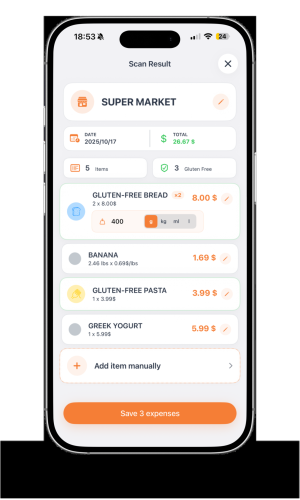
Once the receipt is scanned, you can easily tap and select the gluten-free items you purchased. In most cases, there's no need to rewrite product names or enter prices manually — and when adjustments are needed, they can be made quickly.
From there, each selected item can be assigned to the appropriate category you've already defined, such as bread or pasta. Glutax applies the correct reference price automatically and tracks the estimated deductible amount in the background, without adding extra steps to your routine.
From daily tracking to a tax‑ready report
Over time, Glutax turns small, everyday actions into a complete annual overview.
When tax season arrives, you can generate a clear, structured PDF report that includes:
- Total estimated deductible amounts
- Itemized calculations by category
- All supporting grocery receipts attached and organized
- Reference price photos included as a structured annex
Each receipt is grouped by month and assigned a unique reference number generated by the app. That same reference number appears directly in the report, making it easy to connect every calculated amount to its original receipt and trace each expense without confusion.
Review the report and share it with your accountant to prepare the claim. Keep it with the supporting documents and provide it to the CRA if requested.
A simpler way to handle an unavoidable reality
Gluten-free food costs are not a lifestyle choice. For people with celiac disease, they are a permanent medical expense — and in Canada, a costly one.
The challenge:
- ✗ 80% of Canadians with celiac disease never claim the credit
- ✗ Year-long tracking of receipts and price comparisons required
- ✗ Complex documentation discourages eligible families
Glutax makes it simple:
- ✓ Organize expenses as you shop
- ✓ Keep receipts structured automatically
- ✓ Generate tax-ready reports in seconds
If claiming the gluten-free tax credit felt too complicated before, Glutax is designed for you.
Ready to claim it? Organize your purchases all year
Knowing the credit exists is step one. Next, learn how to track and calculate the gluten-free difference without a spreadsheet:
Track gluten-free tax expenses without a spreadsheet →Frequently asked questions
You claim it as a medical expense with the CRA. For each gluten-free product, you deduct only the price difference between it and a comparable regular product, not the full price. Keep a medical practitioner's letter confirming celiac disease and the need for a gluten-free diet, receipts, and a product summary showing the extra-cost calculations.
Only the extra cost, not the full grocery bill. The gluten-free tax credit is a non-refundable credit based on the price difference between gluten-free items and their regular gluten-containing equivalents. It does not refund money directly; it reduces the tax you owe.
Keep a medical practitioner's letter confirming celiac disease and the need for a gluten-free diet, your receipts, and a product summary with your calculations. Retain the comparable-price evidence too. Provide the documents if the CRA requests them.
You don't need it. Gluten-free food is claimed as a medical expense, not through the Disability Tax Credit (DTC), and the CRA does not allow a DTC claim for the extra time it takes to shop for or prepare gluten-free food. To claim the medical expense, you need a letter from a doctor confirming your celiac diagnosis, your receipts, and the price-difference calculation for each product.
There is no fixed amount. You claim the extra cost of gluten-free products (their price minus a comparable regular product), which often runs a few hundred dollars a year. That amount is added to your other medical expenses and only reduces your tax on the portion above the yearly threshold, the lesser of 3% of your net income or a fixed amount the CRA sets each year. Since the credit is non-refundable, the final value also depends on the tax you owe.